
The third umpire in cricket helps on-field umpires make accurate decisions using television replays and approved technology. From close run-outs to disputed catches and LBW appeals, the third umpire examines incidents under the applicable playing conditions.
The International Cricket Council (ICC) sets out the rules governing third-umpire referrals, the Decision Review System (DRS) and the technology available during international matches. These rules also explain how player reviews work and what happens when the evidence is inconclusive.
What Is a Third Umpire in Cricket?
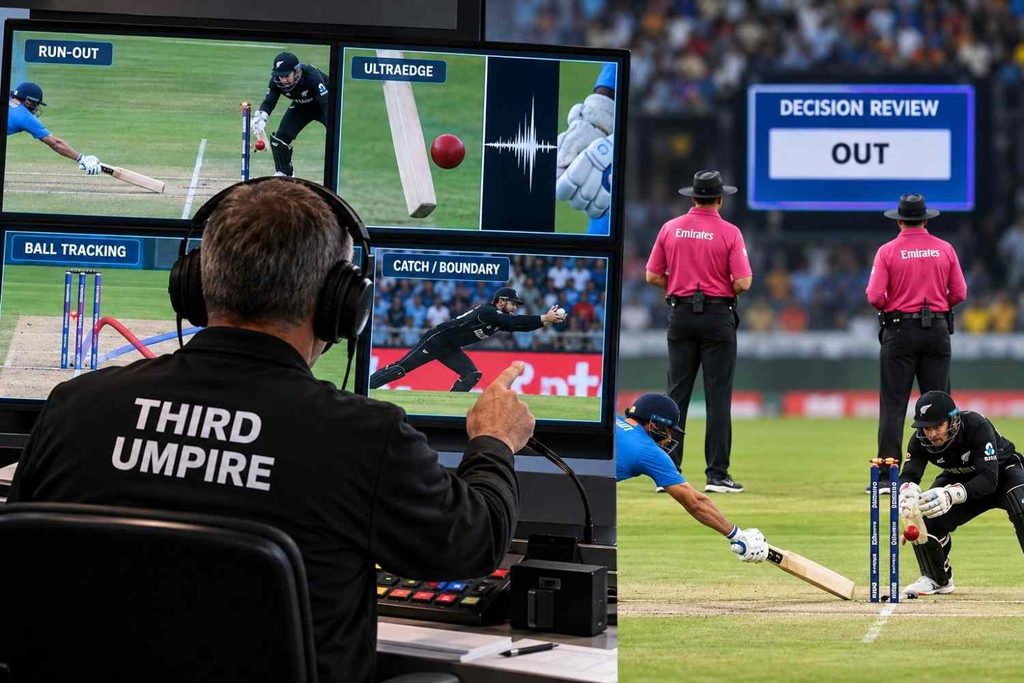
A third umpire is a match official who reviews specific incidents using television replays and, when available, approved decision-review technology. The official usually works in a designated room with access to camera footage and communication equipment.
The third umpire supports the two on-field umpires, who remain responsible for controlling the match on the field. The third umpire can examine referrals initiated by on-field umpires and player reviews requested under DRS.
The official also checks front-foot no-balls and reviews called short runs under ICC international playing conditions.
History of the Third Umpire in Cricket
A major milestone in third-umpire history occurred on 14 November 1992, during the first Test between South Africa and India at Kingsmead in Durban.
Sachin Tendulkar became the first player to be given out through a television-replay decision in international cricket. He was run out for 11 while attempting a risky single.
Jonty Rhodes was fielding at point and fielded the ball before throwing it towards the wicket, where Andrew Hudson broke the stumps. Tendulkar had been sent back by the non-striker, Ravi Shastri.
Square-leg umpire Cyril Mitchley referred the decision to third umpire Karl Liebenberg, who examined the television replay and confirmed the run-out.
The incident took place during India’s first tour of South Africa after the country returned to international cricket following the end of apartheid-era sporting isolation. The decision marked an important development in the use of television technology in cricket officiating.
Over time, the role expanded with the introduction of the Decision Review System and technologies such as Hawk-Eye and UltraEdge.
Role and Responsibilities of the Third Umpire
The third umpire examines eligible incidents and provides the findings required under the applicable playing conditions.
1. Reviewing Run-Out Decisions
Run-outs are among the most familiar incidents referred to the third umpire. The official examines camera angles to determine whether the batter was in their ground when the wicket was broken.
If the evidence shows that the batter had not made their ground in time, the batter can be given out. Otherwise, the batter is not out.
2. Checking Stumping Decisions
For a stumping decision, the third umpire checks whether the striker was out of their ground when the wicketkeeper legally put down the wicket.
The official also checks the relevant footage to determine whether the dismissal satisfies the Laws of Cricket.
3. Examining Catches
The third umpire reviews disputed catches to determine whether the ball touched the ground before the fielder completed the catch and whether the fielder maintained control.
The official can also examine whether the batter hit the ball and whether the delivery was a no-ball when the applicable procedure requires those checks.
The soft signal was abolished in international cricket effective 1 June 2023. On-field umpires no longer need to give an initial out or not-out signal when referring a catch to the TV umpire. The on-field umpires consult the TV umpire before the decision is made.
The change followed recommendations from the Men’s Cricket Committee led by Sourav Ganguly and endorsed by the Women’s Cricket Committee. Ganguly explained that soft signals were unnecessary and could cause confusion when replays were inconclusive.
The IPL had already removed soft signals for the 2021 season, two years before the international change.
4. Reviewing Boundary Decisions
The third umpire examines whether a four or six has been scored and whether a fielder touched the boundary while in contact with the ball.
Camera replays help determine whether the ball or fielder crossed the boundary in a way that affects the result.
5. Assisting With Other Dismissals
The third umpire can examine other dismissal-related incidents when the playing conditions permit a referral. These include certain caught decisions, obstructing the field and other incidents covered by the relevant review procedure.
6. Checking Front-Foot No-Balls
In international cricket, the third umpire checks the bowler’s front-foot landing using television replays. If the delivery is illegal because the front foot does not meet the requirements of the playing conditions, the third umpire informs the on-field umpire, who calls and signals no-ball.
This check helps identify overstepping that may be difficult to spot in real time.
7. Reviewing Short Runs
The third umpire automatically reviews a short-run call under ICC Test and T20I playing conditions. The official communicates the findings to the relevant on-field umpire, allowing an incorrect call to be corrected before play proceeds.
8. Acting as the Emergency On-Field Umpire
The third umpire has another defined responsibility: acting as the emergency on-field umpire if one of the two on-field umpires cannot continue, in accordance with the applicable playing conditions.
Which Decisions Can the Third Umpire Review?
| Decision or incident | What the third umpire examines |
| Run-out | Whether the batter was in their ground when the wicket was broken |
| Stumping | Whether the batter was out of their ground and the wicket was put down legally |
| Caught | Whether the catch was completed fairly and the ball carried before touching the ground |
| Boundary decision | Whether the ball or fielder touched the boundary |
| LBW | The point of pitching, impact and projected path of the ball when DRS is available |
| Bat or pad contact | Whether the ball hit the bat before hitting the batter’s body |
| Front-foot no-ball | Whether the bowler’s front foot landed legally |
| Short run | Whether the called short run was correctly identified |
| Other dismissal incidents | Whether the applicable playing conditions permit the referral |
Not every decision can be reviewed automatically. The available procedures depend on the competition and its playing conditions.
How Does the Decision Review System Work?
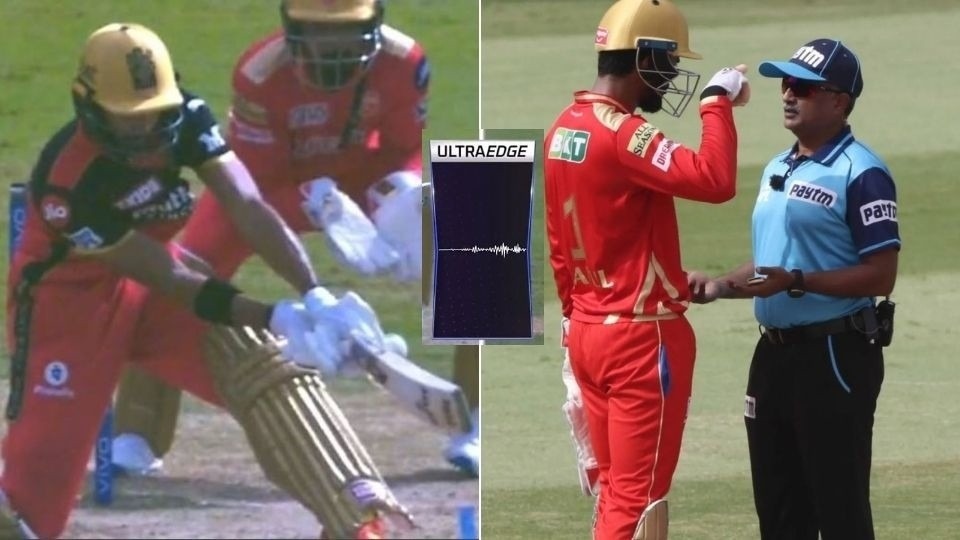
Source Image: Hindustan Times
The Decision Review System allows match officials to use approved technology to examine certain decisions. The ICC distinguishes between an Umpire Review, initiated by an on-field umpire, and a Player Review, requested by a team.
Umpire Review
An on-field umpire may refer an eligible incident to the third umpire when additional evidence is required. A close run-out is a common example.
The third umpire examines the permitted footage and communicates the findings to the on-field umpire, who completes the decision under the applicable playing conditions.
Player Review
A Player Review allows a team to challenge an eligible on-field decision when DRS is available. For example, a team may request a review of an LBW decision.
The player or captain must make the prescribed T-sign within 15 seconds after the ball becomes dead. The on-field umpire can prompt the player after 10 seconds if a review has not been requested.
Under the current ICC Men’s Test playing conditions effective October 2026, each team may make up to three unsuccessful Player Review requests per innings. Under the current ICC Men’s T20I playing conditions, each team may make up to two unsuccessful requests per innings. Successful reviews do not count towards these limits.
An LBW review resulting in Umpire’s Call also does not count towards the innings limit under these playing conditions.
What Technology Does the Third Umpire Use?
The technology available depends on the competition and the type of review.
Hawk-Eye
Hawk-Eye provides ball-tracking technology. During an eligible LBW review, it helps the third umpire assess where the ball pitched, where it struck the batter and whether it would have hit the stumps.
These three elements are commonly described as pitching, impact and wicket.
UltraEdge
UltraEdge is an approved sound-based edge-detection system used to help determine whether the ball made contact with the bat.
The third umpire examines the synchronized video and audio graph. A sharp audio spike around the moment the ball passes the bat can indicate contact. The official also checks the ball’s position in the video and considers other available evidence.
Snickometer
Snickometer is another name associated with sound-based edge detection. It helps officials investigate possible contact between the ball and bat.
Hot Spot
Hot Spot uses heat-based imaging to help identify contact between the ball and the bat or other equipment. A visible heat mark can provide evidence of contact, although the third umpire must consider the complete available evidence.
Television Replays and Slow Motion
Multiple camera angles and slow-motion footage help the third umpire examine run-outs, stumpings, catches and boundary decisions.
In a match without DRS, the third umpire has access to camera replays only. Ball-tracking and edge-detection systems such as Hawk-Eye and UltraEdge are not available as DRS review tools in such a match.
Not every competition uses every technology. The equipment and procedures depend on the applicable playing conditions.
What Happens When the Evidence Is Inconclusive?
The third umpire must follow the applicable review procedure when the available evidence is inconclusive.
For a referred catch, the soft signal no longer determines the outcome in international cricket. The third umpire examines the available footage and makes the decision under the current procedure.
For a DRS review, if the evidence does not establish that the original on-field decision should be changed, the original decision stands. In an LBW review, Umpire’s Call means that the on-field decision remains unchanged because the ball-tracking result falls within the specified marginal range.
A technical failure is different from inconclusive evidence. The ICC playing conditions provide separate procedures for dealing with failures of review technology.
Third Umpire vs On-Field Umpire
| Feature | On-field umpire | Third umpire |
| Main location | On the cricket field | Designated review room |
| Primary role | Controls the match and makes on-field decisions | Examines eligible referrals and reviews |
| Main evidence | Direct observation of play | Television replays and approved technology |
| Player reviews | Receives appeals and signals the review | Examines the evidence and communicates findings |
| Front-foot checks | Receives the no-ball information and signals the decision | Checks front-foot landing using television replays |
| Short-run checks | Calls and signals the short run | Reviews the call and communicates the findings |
| Emergency responsibility | Continues on-field duties while able | Can act as the emergency on-field umpire if required |
Both officials are part of the match officiating team. The third umpire supports on-field decision-making and operates within the authority defined by the playing conditions.
What Powers Does the Third Umpire Have?
The third umpire can examine eligible referrals, use permitted footage and technology, and communicate the findings needed to resolve a decision.
The official can help correct run-out, stumping, catch and boundary decisions, check front-foot no-balls, review short-run calls and examine eligible DRS appeals.
The third umpire cannot independently reopen every incident simply because television footage exists. The official must follow the relevant review procedure and the technology permitted for that match.
In a match without DRS, the third umpire’s work is limited to the television-replay procedures available under that competition’s playing conditions.
Why Is the Third Umpire Important in Cricket?
The third umpire helps reduce errors in decisions that are difficult to make in real time. This is particularly important for close run-outs, stumpings, boundary catches and LBW appeals.
Technology gives officials additional evidence that may not be visible at normal speed. It also helps them review front-foot no-balls and correct short-run calls.
However, technology does not eliminate every disagreement. The available camera angles may be limited, evidence may be inconclusive, and some decisions still require interpretation of the Laws of Cricket.
Conclusion
The third umpire is an important part of modern cricket officiating. By examining close run-outs, stumpings, catches, boundary incidents and eligible DRS appeals, the official helps match officials make more accurate decisions.
The role also includes checking front-foot no-balls, reviewing short-run calls and acting as the emergency on-field umpire when required. The abolition of the soft signal in international cricket in 2023 changed how referred catches are decided.
Understanding the third umpire’s responsibilities, the technology used and the rules governing reviews helps spectators follow cricket decisions more clearly.
Frequently Asked Questions
The third umpire is a match official who examines eligible incidents using television replays and approved technology. The official assists the on-field umpires with referrals and player reviews permitted under the playing conditions.
Yes. The third umpire can provide findings that lead to a decision being changed under the applicable review procedure.
Yes, when DRS is available and the decision is eligible for review. The third umpire can use ball-tracking and other approved technology to assess the delivery.
Under the ICC Men’s playing conditions effective October 2026, each team gets up to three unsuccessful Player Reviews per innings in Test cricket and two in T20 Internationals. Successful reviews and reviews retained on Umpire’s Call do not count towards these limits.
A team must request a Player Review within 15 seconds after the ball becomes dead, subject to the specific exception in the applicable playing conditions.