
Fielding can change a cricket match in seconds. A spectacular catch, a direct hit from the boundary or a brilliant stop can turn a difficult situation into a winning opportunity. While batters and bowlers often get the most attention, exceptional fielders can contribute just as much.
So, who is the best fielder in the world right now? India’s Ravindra Jadeja remains a leading candidate because of his throwing accuracy, ground coverage, and consistency. New Zealand’s Glenn Phillips is another strong contender, particularly for his extraordinary athletic catches. Australia’s Steve Smith has also strengthened his reputation by becoming the leading non-wicketkeeper catcher in Test cricket.
Meanwhile, India’s Tilak Varma made headlines in October 2026 by setting a new men’s T20 International record for catches in a calendar year.
There is no official world ranking that settles this debate. Catching ability, run-out potential, ground fielding, athleticism and consistency under pressure all contribute to a player’s reputation.
Who Is the Best Fielder in the World?
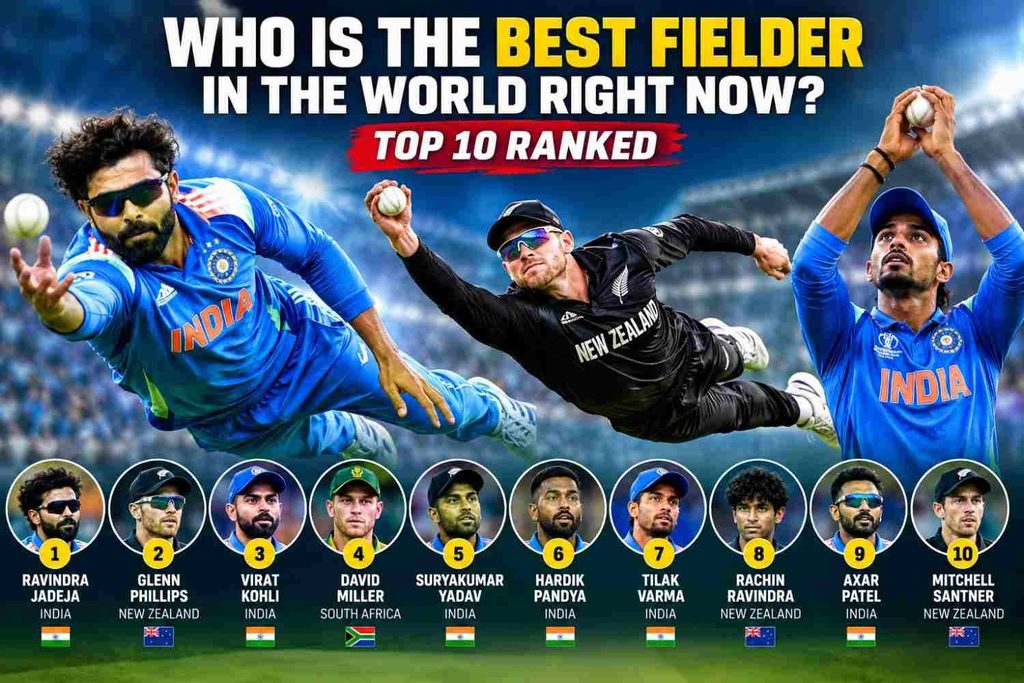
Ravindra Jadeja is a leading choice for the best all-round fielder in the world, while Glenn Phillips stands out for athletic catches. Steve Smith’s Test catching record and David Miller’s T20I catching achievements provide further evidence of the exceptional fielding standards in international cricket.
Jadeja combines quick reflexes, a powerful throwing arm and excellent anticipation. He can stop singles, create run-out opportunities and take difficult catches in the inner circle or outfield. His international experience strengthens his case for consistency across different fielding situations.
Phillips offers a different kind of brilliance. His speed, agility and ability to dive at full stretch have produced several memorable catches. During the 2025 ICC Champions Trophy, his catch to dismiss Virat Kohli in the group stage and his catch of Shubman Gill in the final demonstrated his exceptional athleticism. Former Australia captain Ricky Ponting praised Phillips’ agility and catching ability.
Steve Smith brings outstanding reflexes and anticipation in the slips. On 11 October 2026, he surpassed Joe Root to become the leading non-wicketkeeper catcher in Test cricket. His record demonstrates how consistent close catching can be just as valuable as spectacular outfield efforts.
For current form, Tilak Varma deserves attention too. On 24 October 2026, he reached 26 catches in men’s T20 Internationals during the calendar year, surpassing the previous record of 25.
These achievements highlight different aspects of fielding excellence. Jadeja is a leading choice for overall ability, Phillips stands out for spectacular catches, Smith excels in Test catching, and Varma has demonstrated remarkable consistency in 2026.
Top 10 Best Fielders in the World Right Now
| Rank | Player | Country | Greatest Fielding Strength |
| 1 | Ravindra Jadeja | India | Direct hits and ground fielding |
| 2 | Glenn Phillips | New Zealand | Athletic catches |
| 3 | Steve Smith | Australia | Slip catching and reflexes |
| 4 | David Miller | South Africa | Safe hands and boundary fielding |
| 5 | Joe Root | England | Slip catching and anticipation |
| 6 | Mohammad Nabi | Afghanistan | Catching consistency and positioning |
| 7 | Tilak Varma | India | Catching consistency |
| 8 | Shadab Khan | Pakistan | Agility and throwing |
| 9 | Pathum Nissanka | Sri Lanka | Reflexes and outfield catching |
| 10 | Shimron Hetmyer | West Indies | Athleticism and boundary fielding |
How to interpret this ranking: This is an editorial assessment of fielding versatility, established ability, notable performances and consistency. It is not an official ICC ranking or a statistically calculated leaderboard.
1. Ravindra Jadeja, India
Ravindra Jadeja is one of the most complete fielders in modern cricket. His quick hands, strong throwing arm and ability to move rapidly across the ground make him dangerous in almost any position.
Jadeja excels in the inner circle, where a fraction of a second can decide whether a batter completes a single. His direct hits can turn half-chances into wickets, while his diving stops prevent batters from collecting easy runs.
His international record includes 158 catches across Tests, ODIs and T20 Internationals, based on the figures of 50 Test catches, 80 ODI catches and 28 T20I catches. His fielding contributions highlight his value beyond batting and bowling
In ODI cricket, Jadeja has scored 2,905 runs, taken 234 wickets and completed 80 catches, underlining his all-round contribution to the format.
He retired from T20 Internationals on 30 June 2024, following India’s T20 World Cup victory. His T20I career remains an important part of his international record.
Jadeja’s reputation rests on his throwing accuracy, ground coverage, quick reflexes and match-changing ability. His strength is not limited to spectacular catches; he can influence a match through routine stops, precise throws and consistent pressure on batters.
2. Glenn Phillips, New Zealand
Glenn Phillips is among the most exciting fielders to watch in international cricket. His speed, explosive jumps and willingness to attempt difficult catches make him particularly effective in the outfield.
During the 2025 ICC Champions Trophy, Phillips produced outstanding catches against India. His catch to dismiss Virat Kohli during the group stage demonstrated his ability to cover ground and complete a difficult chance. He also caught Shubman Gill in the final against India.
Phillips’ performances attracted praise from former Australia captain Ricky Ponting, who highlighted his agility, coordination and ability to complete difficult catches while diving.
Although spectacular catches are only one part of fielding, Phillips has repeatedly demonstrated why athleticism can make a significant difference in major matches.
He ranks second because his exceptional range, speed and ability to convert difficult chances into wickets make him one of the strongest contenders for the best athletic fielder in international cricket.
3. Steve Smith, Australia
Steve Smith has strengthened his reputation as one of the finest close fielders in Test cricket. His anticipation, sharp reflexes and ability to react to edges make him particularly effective in the slips.
On 11 October 2026, Smith surpassed England’s Joe Root to become the leading non-wicketkeeper catcher in Test cricket. His tally subsequently reached 224 Test catches, establishing a new benchmark for specialist fielders in the format.
Smith achieved the record through consistent performances across a long Test career. His ability to read a batter’s shot, adjust his position quickly and hold difficult chances has made him an important part of Australia’s bowling attack.
Slip fielding requires concentration and excellent hand-eye coordination because the ball can travel quickly off the edge of the bat. Smith’s record reflects his ability to perform these tasks repeatedly under pressure.
He ranks third because his catching record provides measurable evidence of exceptional fielding ability. Although his strongest reputation comes from Test cricket, his achievement deserves recognition in any discussion of the world’s leading fielders.
4. David Miller, South Africa
David Miller is a dependable fielder with excellent hands and strong awareness near the boundary. He can take difficult catches and control the ball quickly enough to prevent additional runs.
His experience in international cricket and franchise T20 competitions has exposed him to numerous high-pressure situations. Boundary fielding demands concentration, awareness of the playing area and precise movement, particularly when a catch must be completed close to the rope.
Miller also holds the record for the most catches by a fielder in men’s T20 Internationals, with 86 catches recorded by Guinness World Records as of 17 October 2026. This total includes three catches taken while representing the ICC World XI in matches against Pakistan in 2017.
Afghanistan’s Mohammad Nabi follows with 83 catches for Afghanistan alone, making Miller’s record a significant achievement in international T20 cricket.
Miller ranks fourth because his catching record complements his composure, athletic ability and experience in demanding match situations. His performances demonstrate the importance of safe hands and consistent execution in limited-overs cricket.
5. Joe Root, England
Joe Root is one of England’s most accomplished close fielders. His anticipation, concentration and ability to react to edges have made him a dependable option in the slips throughout his international career.
Root previously held the record for the most catches by a non-wicketkeeper in Test cricket, reaching 220 before Steve Smith surpassed him in October 2026.
His record remains an important measure of consistency. Taking catches in Test cricket requires patience and concentration over long periods, particularly when fielders spend several sessions in the slips waiting for opportunities.
Root’s ability to maintain focus and react quickly has contributed to England’s fielding efforts across different conditions and opponents.
He ranks fifth because his Test catching record provides a strong statistical foundation for his inclusion among the world’s leading fielders. Smith may now hold the record, but Root’s achievement remains a significant marker of fielding excellence.
6. Mohammad Nabi, Afghanistan
Mohammad Nabi is a highly experienced international cricketer whose fielding deserves recognition alongside his contributions with the bat and ball.
His T20I catching record is particularly notable. As of September 2026, Nabi had taken 83 catches for Afghanistan in men’s T20 Internationals, placing him among the format’s leading fielders.
Catching consistency is especially valuable in T20 cricket, where a single wicket can change the momentum of an innings. Fielders must react quickly, maintain concentration and judge the ball accurately under pressure.
Nabi’s extensive experience across international and franchise cricket has exposed him to a wide range of fielding situations. His positioning and awareness contribute to Afghanistan’s ability to create opportunities and restrict opposition scoring.
He ranks sixth because his international experience and verified T20I catching record demonstrate sustained fielding value. His inclusion also recognises that exceptional fielding talent extends well beyond the most frequently discussed cricketing nations.
7. Tilak Varma, India
Tilak Varma has provided a strong statistical reason to enter the fielding conversation in 2026. On 24 October, he reached 26 catches in men’s T20 Internationals during the calendar year, surpassing the previous record of 25.
The milestone came during India’s second T20I against New Zealand at Hagley Oval in Christchurch. Varma took the catches of Tim Seifert and Daryl Mitchell within the opening three overs.
Seifert was caught at cover off Arshdeep Singh, while Mitchell was dismissed after edging a delivery from Bhuvneshwar Kumar towards Varma.
Varma reached the record in 32 matches, compared with Danilson Hawoe’s previous mark of 25 catches in 41 matches. Varma had also missed India’s home series in January through injury before returning to international action.
The previous calendar-year record holders were:
| Catches | Player | Country | Year |
| 26 | Tilak Varma | India | 2026 |
| 25 | Danilson Hawoe | Indonesia | 2025 |
| 24 | Muhammad Waseem | UAE | 2024 |
| 21 | Sharvin Muniandy | Malaysia | 2025 |
| 20 | Brian Masaba | Uganda | 2023 |
Tilak’s achievement is particularly significant because he surpassed the previous record with two early catches in the same match. As India’s T20I vice-captain, his fielding contributions have added another dimension to his international role.
8. Shadab Khan, Pakistan
Shadab Khan is known for his agility, quick reactions and ability to contribute in different fielding positions. His experience in international limited-overs cricket has required him to respond quickly to attacking shots and create pressure on batters.
A fielder’s value extends beyond catches. Quick collection, accurate throwing and the ability to stop singles can change the outcome of close matches. Shadab’s mobility and awareness make these qualities particularly relevant in shorter formats.
His experience in T20 cricket also exposes him to demanding situations in which fielders must anticipate powerful shots and judge difficult chances near the boundary.
Shadab ranks eighth because his athleticism and versatility make him a useful option in modern limited-overs cricket. His inclusion also broadens the ranking beyond a narrow group of players from India, New Zealand and South Africa.
9. Pathum Nissanka, Sri Lanka
Pathum Nissanka has developed into an important member of Sri Lanka’s international batting lineup, while his fielding adds value to the team’s overall performance.
Outfield fielding requires good anticipation, quick movement and the ability to judge the ball’s trajectory. A well-timed catch or a sharp stop can prevent scoring opportunities and create pressure during an innings.
Nissanka’s role in international cricket places him in a variety of fielding situations, where positioning and concentration remain essential. Reliable fielding is especially important in limited-overs matches, where small differences in the number of runs conceded can influence the result.
He ranks ninth as a contemporary fielder whose agility and outfield contributions deserve recognition. His inclusion also ensures that the ranking reflects the wider international game rather than focusing only on a few established teams.
10. Shimron Hetmyer, West Indies
Shimron Hetmyer brings athleticism and quick reactions to West Indies’ fielding unit. His experience in international and franchise T20 cricket has exposed him to situations in which fielders must judge difficult catches and respond rapidly to powerful shots.
Boundary fielding requires awareness of the rope, good balance and precise movement. A fielder must control the body while tracking the ball and ensure that a catch is completed legally.
Hetmyer’s athletic ability and experience in limited-overs cricket make him a useful option in the outfield. His fielding contribution is not limited to spectacular catches; positioning and preventing runs are also important parts of his role.
He ranks tenth in this editorial assessment because of his athleticism and potential to make a difference in the field. His inclusion also broadens the geographical representation of the list to include the West Indies.
Best Fielders in Cricket History
The best fielder today is not necessarily the greatest fielder of all time. Several retired players changed the way teams approached fielding and remain benchmarks for modern cricketers.
| Player | Country | Known For |
| Jonty Rhodes | South Africa | Ground fielding and run-outs |
| AB de Villiers | South Africa | Athleticism and versatility |
| Ricky Ponting | Australia | Sharp reflexes and throwing |
| Suresh Raina | India | Inner-circle fielding |
| Andrew Symonds | Australia | Powerful throws and catches |
| Herschelle Gibbs | South Africa | Athletic outfield catches |
| Mahela Jayawardene | Sri Lanka | Slip catching |
| Paul Collingwood | England | All-round fielding |
Jonty Rhodes: A Fielding Legend
Jonty Rhodes is widely regarded as one of the greatest fielders in cricket history. He helped transform expectations of ground fielding through his speed, diving stops and direct hits.
His famous run-out of Inzamam-ul-Haq during the 1992 Cricket World Cup remains one of the most memorable fielding moments in the sport. Rhodes sprinted towards the stumps and completed a direct-hit run-out, demonstrating how anticipation and athleticism could create wickets without the bowler needing to beat the batter.
His statistical record also demonstrates his contribution. Rhodes took 105 catches in Test cricket and 127 catches in ODIs for South Africa.
His influence extended beyond individual highlights. Rhodes helped demonstrate the importance of dedicated fielding skills, quick movement and aggressive ground fielding in international cricket.
AB de Villiers: Exceptional Athleticism
AB de Villiers was an outstanding all-round fielder who could perform effectively in different positions. His agility and coordination allowed him to take difficult catches and react quickly to the ball.
His versatility was particularly useful in limited-overs cricket, where fielders must adapt to different positions and situations. De Villiers’ reputation as an exceptional athlete extended beyond his batting achievements.
Ricky Ponting: Sharp Reflexes and Anticipation
Ricky Ponting was known for his sharp reflexes, strong throwing and ability to anticipate a batter’s intentions. He was effective in close fielding positions and could react quickly when the ball travelled towards him.
His experience as an international captain also highlighted the tactical importance of positioning fielders correctly. Ponting remains one of the prominent names in discussions about the finest fielders in cricket history.
Suresh Raina: India’s Fielding Standard Setter
Suresh Raina helped raise expectations for Indian fielding in limited-overs cricket. His speed, enthusiasm and direct hits made him particularly effective in the inner circle.
His contribution was not limited to spectacular moments. Raina also demonstrated how consistent ground fielding could restrict scoring and create pressure on opposing batters.
His legacy remains important in discussions about India’s development into a more athletic fielding side.
Andrew Symonds: Powerful Throws and Athleticism
Andrew Symonds was known for his strength, athleticism and powerful throwing arm. He could cover ground quickly in the outfield and put pressure on batters attempting to take quick singles.
His ability to combine athletic catches with strong, accurate throws made him a valuable fielder for Australia in international cricket. Symonds’ physical strength and quick reactions also helped him handle demanding fielding situations, particularly in limited-overs matches.
His fielding reputation extended beyond individual catches. His ability to stop runs and create pressure on batters made him an important part of Australia’s fielding unit.
Herschelle Gibbs: Exceptional Outfield Catching
Herschelle Gibbs was a talented South African fielder known for his athleticism and ability to take challenging catches. His speed and coordination helped him cover ground in the outfield, while his anticipation allowed him to react quickly to attacking shots.
Gibbs was also involved in some memorable moments in international cricket, demonstrating how concentration and quick reactions can turn difficult chances into wickets.
His combination of agility, catching ability and outfield awareness makes him a notable name among the outstanding fielders of his generation.
Mahela Jayawardene: Outstanding Slip Fielder
Mahela Jayawardene was renowned for his catching ability, particularly in the slips. His concentration, soft hands and quick reactions helped him take difficult chances off both fast bowlers and spinners.
His record demonstrates his exceptional consistency. Jayawardene took 205 catches in Test cricket and finished his international career with 440 catches across Tests, ODIs and T20 Internationals, the highest all-format total for a non-wicketkeeper.
Slip fielding requires excellent anticipation because the ball can travel quickly off the edge of the bat. A fielder must react immediately, maintain the correct hand position and judge the ball’s movement.
Jayawardene’s consistency in close-catching positions made him an important part of Sri Lanka’s fielding unit throughout his international career. His example highlights why catching in the slips is a specialised skill that deserves recognition alongside boundary fielding and direct-hit run-outs.
Paul Collingwood: England’s Reliable All-Round Fielder
Paul Collingwood was recognised for his commitment, athleticism and dependable fielding for England. He could contribute in different positions, take difficult catches and help restrict runs through sharp ground fielding.
His versatility was particularly useful in limited-overs cricket, where fielders need to adapt to different positions and tactical situations. Collingwood’s commitment to saving runs and maintaining pressure made him a valuable member of England’s teams.
His reputation as an all-round fielder reflects the importance of consistency, concentration and teamwork, rather than spectacular catches alone.
How Do We Decide Who Is the Best Fielder?
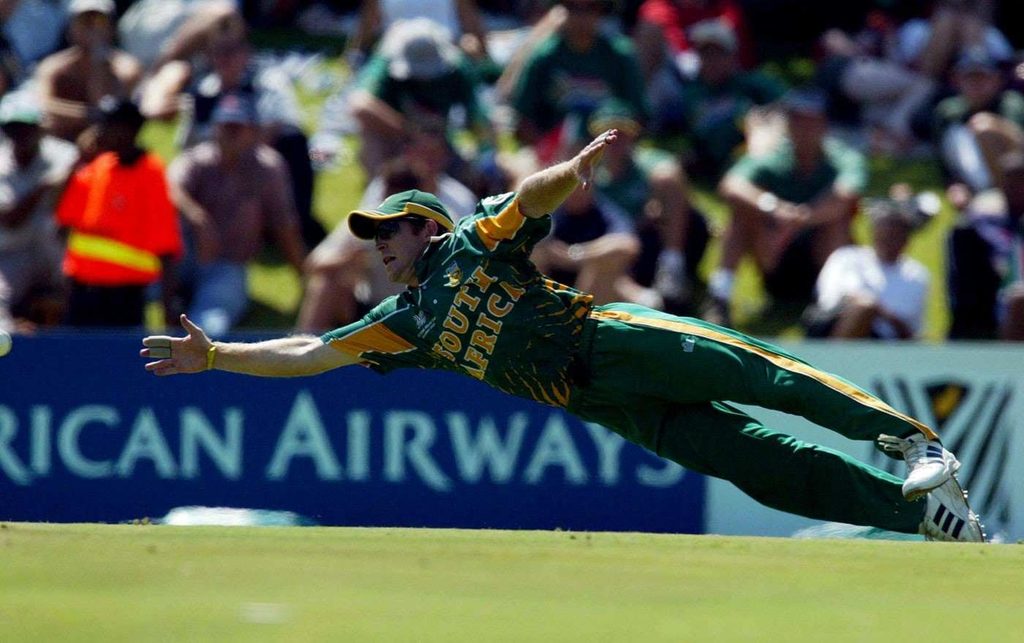
A fair ranking should assess more than highlight catches. Five factors are particularly important when comparing fielders.
- Catching ability: The fielder should hold difficult chances consistently, not just take spectacular catches occasionally.
- Run-out ability: Throwing accuracy, release speed and awareness determine whether a chance becomes a dismissal.
- Ground fielding: Quick movement and clean collection help prevent singles and boundary scoring.
- Athleticism: Speed, agility, balance and coordination allow players to reach balls that others cannot.
- Consistency under pressure: Reliable fielding in close matches is more valuable than occasional brilliance.
These criteria do not have universally accepted numerical weights in this ranking. Instead, they provide a framework for comparing established fielding strengths and notable performances.
One important limitation is that official scorecards do not comprehensively measure every run saved. They record catches and run-outs, but a diving stop that prevents four runs may not appear as a separate statistical achievement. Similarly, a fielder’s positioning can discourage a batter from attempting a run without producing a recorded statistic.
This is why verified statistics should be combined with a careful assessment of a player’s overall fielding ability. Catch totals alone cannot establish who is the best fielder in the world.
Conclusion
The debate over who is the best fielder in the world depends on how fielding excellence is measured. Ravindra Jadeja is a strong choice for overall ability, Glenn Phillips stands out for spectacular catches, Steve Smith leads the Test catching record, and Tilak Varma’s 2026 catching achievement demonstrates the importance of current form.
Jonty Rhodes remains a benchmark when discussing the greatest fielders in cricket history. Other outstanding players, including AB de Villiers, Ricky Ponting, Suresh Raina, Andrew Symonds, Herschelle Gibbs, Mahela Jayawardene and Paul Collingwood, have also demonstrated the importance of exceptional fielding.
Ultimately, the best fielders are those who consistently save runs, take difficult catches, create run-out opportunities and perform under pressure. While no single ranking can settle the debate, these players demonstrate why fielding remains one of cricket’s most influential skills.
Frequently Asked Questions
Ravindra Jadeja is a leading choice for the best all-round fielder because of his direct hits, quick reflexes and consistent ground fielding. Glenn Phillips is another leading contender, particularly for athletic catches. The final choice depends on how different fielding skills are valued.
Jonty Rhodes is widely regarded as one of the greatest fielders ever. His speed, diving stops and famous run-outs helped change how teams valued fielding. Other notable names include AB de Villiers, Ricky Ponting and Suresh Raina.
Ravindra Jadeja is a strong choice because of his throwing accuracy, ground coverage and ability to create run-outs. Virat Kohli and Suresh Raina are also notable names in discussions about India’s best fielders.
Tilak Varma set the record with 26 catches in 2026, surpassing the previous mark of 25 held by Danilson Hawoe of Indonesia. He achieved the milestone on 24 October 2026.
Jadeja has the stronger case for all-round consistency, particularly in ground fielding and direct-hit run-outs. Phillips stands out for acrobatic catches and explosive athleticism. The better choice depends on which fielding skills are given the most weight.