
Timed out in cricket is one of the rarest ways a batter can lose a wicket. Unlike bowled, caught or LBW, this dismissal can happen before a batter faces a single delivery. The rule requires an incoming batter to be ready within a specified time after the previous wicket falls or a batter retires.
Sri Lanka’s Angelo Mathews made international cricket history when Bangladesh dismissed him timed out during the 2023 Cricket World Cup. He became the first batter to be dismissed this way in international cricket. In June 2026, Bhutan’s Ritshi Choden became the first woman to be dismissed by time-out in international cricket.
Several domestic players had experienced the same dismissal over the preceding decades. Their cases show how delays between wickets can lead to unusual outcomes.
This overview explains the timed-out rule in cricket, the official time limits, 10 notable documented cases and the history behind these rare dismissals.
What Is Timed Out in Cricket?
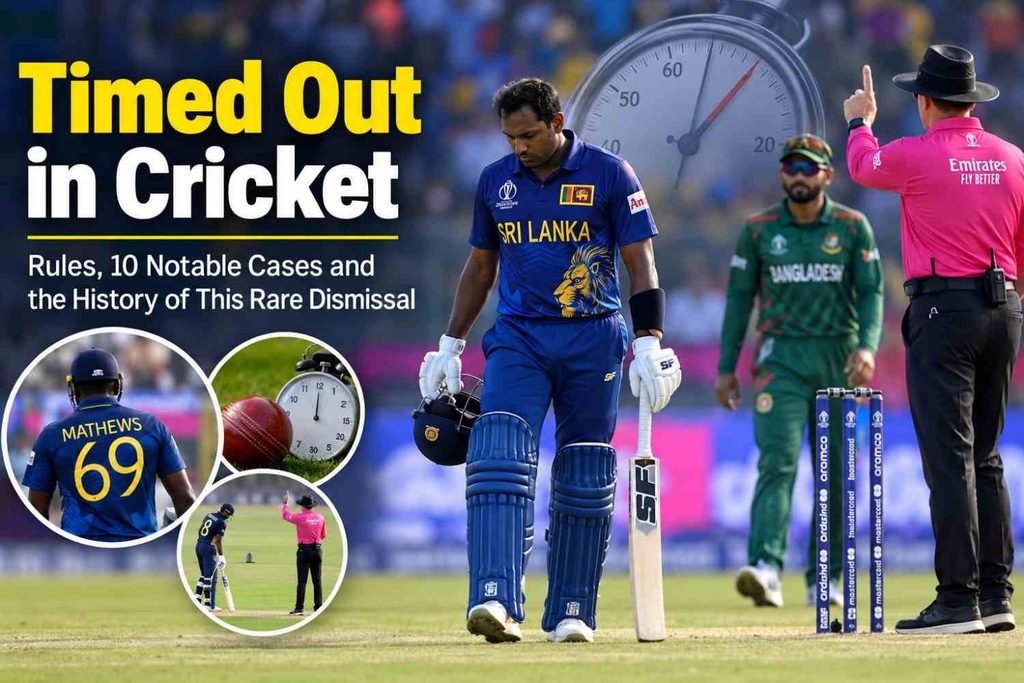
Timed out is a method of dismissal under Law 40 of the Marylebone Cricket Club (MCC) Laws of Cricket.
A batter can be dismissed timed out if, after a wicket falls or a batter retires, the incoming batter is not ready to receive the next ball—or the other batter is not ready to receive it—within the applicable time limit.
The MCC Laws of Cricket 2017 Code, Fourth Edition, took effect on 1 October 2026. Under Law 40.1.1, the standard three-minute limit remains unchanged. However, competitions may specify shorter limits through their playing conditions.
For example, the ICC Men’s Cricket World Cup 2023 allowed two minutes, while applicable ICC T20 International playing conditions can specify a 90-second limit. The rules for the particular competition determine which time limit applies.
Simply arriving at the crease does not necessarily satisfy the rule. The incoming batter must be ready to receive the ball within the required period.
The fielding side must appeal before the umpires can give the batter out timed out.
Key fact: A batter can be dismissed timed out without facing a delivery, and the bowler receives no credit for the wicket.
What Is the Timed Out Rule in Cricket?
The timed-out rule prevents unnecessary delays when a new batter enters the field. It helps ensure that matches continue without excessive interruptions between dismissals.
Under Law 40, the requirement applies when a batter is dismissed or retires and another batter must be ready for the next delivery.
How Does a Timed-Out Dismissal Work?
- A wicket falls, or a batter retires.
- The incoming batter must be ready to receive the ball, or the other batter must be ready to receive it, within the applicable time limit.
- If the requirement is not met, the fielding side can appeal.
- The umpires assess the appeal under the relevant Laws and playing conditions.
- If the appeal is upheld, the incoming batter is dismissed timed out.
A batter is not automatically given out when the time limit expires. An appeal is required, and the umpires determine whether the dismissal is valid.
How Much Time Does a Batter Get in Cricket?
The permitted time depends on the Laws and playing conditions governing the match.
| Rules or competition | Time allowed |
| Standard MCC Laws | Three minutes |
| ICC Men’s Cricket World Cup 2023 | Two minutes |
| Applicable ICC T20I playing conditions | 90 seconds |
| Other domestic and international competitions | As specified in their playing conditions |
The MCC Laws of Cricket 2017 Code, Fourth Edition, took effect on 1 October 2026. Law 40.1.1 retains the standard three-minute limit. International tournaments and other competitions can apply different limits.
For this reason, players must follow the playing conditions for their specific match rather than assume that every cricket format uses the same deadline.
Timed Out in Cricket: List of 10 Notable Cases
Timed-out dismissals have remained extremely uncommon throughout cricket history.
Wisden’s published list records nine men’s professional timed-out dismissals. In June 2026, Bhutan’s Ritshi Choden became the first woman to be dismissed timed out in international cricket.
The following combines those nine men’s professional cases with Choden’s historic women’s international dismissal. These are 10 notable documented cases, not a complete count of every timed-out dismissal in cricket history.
| No. | Player | Team | Opponent | Season or year |
| 1 | Andrew Jordaan | Eastern Province | Transvaal | 1987–88 |
| 2 | Hemulal Yadav | Tripura | Orissa | 1997–98 |
| 3 | Vasbert Drakes | Border | Free State | 2002–03 |
| 4 | Andrew Harris | Nottinghamshire | Durham UCCE | 2003 |
| 5 | Ryan Austin | Combined Campuses and Colleges | Windward Islands | 2013–14 |
| 6 | Charles Kunje | Matabeleland Tuskers | Mountaineers | 2017–18 |
| 7 | Angelo Mathews | Sri Lanka | Bangladesh | 2023 |
| 8 | Godfred Bakiweyem | Ghana | Sierra Leone | 2023–24 |
| 9 | Saud Shakeel | State Bank of Pakistan | Pakistan Television | 2024–25 |
| 10 | Ritshi Choden | Bhutan Women | Nepal Women | 2026 |
1. Andrew Jordaan: The First Recorded Men’s Professional Case
Andrew Jordaan of Eastern Province was dismissed timed out against Transvaal during the 1987–88 South African domestic cricket season.
His dismissal is the earliest entry in Wisden’s documented list of men’s professional timed-out cases.
Jordaan had been not out overnight, but heavy rain and flooded streets delayed his journey to the ground the following morning. His dismissal remains an early example of this unusual mode of losing a wicket.
2. Hemulal Yadav: The Indian Domestic Cricket Case
Hemulal Yadav was dismissed timed out while representing Tripura against Orissa during the 1997–98 Ranji Trophy season.
According to historical accounts reported by Wisden, Yadav was talking with his team manager instead of making his way to the crease after a wicket fell.
The delay resulted in a timed-out dismissal.
Yadav’s case is one of the best-known examples of this dismissal in Indian domestic cricket. It illustrates how a batter’s failure to be ready within the required period can lead to a wicket even without a delivery being bowled.
3. Vasbert Drakes: The Batter Delayed by a Flight
West Indies cricketer Vasbert Drakes was dismissed timed out while representing Border against Free State during the 2002–03 South African domestic season.
Drakes was unable to reach the ground in time because of a delayed flight. Historical reporting indicates that he was still on another continent when he was ruled out.
The opposition appealed, and the dismissal was recorded as timed out.
His case is unusual because the delay was connected to travel rather than an incident at the crease.
It demonstrates that the rule can have consequences even when a batter’s absence is caused by circumstances beyond the immediate action on the field.
4. Andrew Harris: The Nottinghamshire Case
Andrew Harris was dismissed timed out while representing Nottinghamshire against Durham UCCE in 2003.
Harris had suffered a groin injury while bowling and was changing out of his tracksuit when the previous wicket fell. He tried to get ready and reach the crease quickly, but could not move fast enough and was declared timed out.
His case remains notable because timed-out dismissals were exceptionally uncommon in English professional cricket.
The incident also demonstrates that the same timing requirement can apply in domestic matches, subject to the playing conditions in force.
5. Ryan Austin: The West Indies Domestic Case
Ryan Austin was dismissed timed out while playing for Combined Campuses and Colleges against the Windward Islands during the 2013–14 season.
The dismissal is included among the documented men’s professional cases.
Published accounts do not establish a confirmed reason for Austin’s delay. He failed to appear in time to bat in the second innings, although he later took the field to bowl.
His dismissal remains an example of the timed-out rule being applied in West Indies domestic cricket.
6. Charles Kunje: The Zimbabwean Domestic Case
Charles Kunje was dismissed timed out while representing Matabeleland Tuskers against Mountaineers during the 2017–18 Zimbabwean domestic season.
His name appears in the documented list of men’s professional timed-out dismissals.
The reason for Kunje’s delay remains unclear in published reports. The dismissal came during a difficult match for Matabeleland Tuskers, who were bowled out for 68 before Mountaineers won by 10 wickets.
Although Kunje’s dismissal received considerably less attention than Angelo Mathews’ later international incident, it remains part of the recorded history of this rare dismissal.
7. Angelo Mathews: The First Timed-Out Dismissal in International Cricket
Angelo Mathews became the first batter to be dismissed timed out in international cricket during the ICC Men’s Cricket World Cup match between Sri Lanka and Bangladesh at the Arun Jaitley Stadium in Delhi on 6 November 2023.
The incident occurred after Bangladesh dismissed Sri Lankan batter Sadeera Samarawickrama.
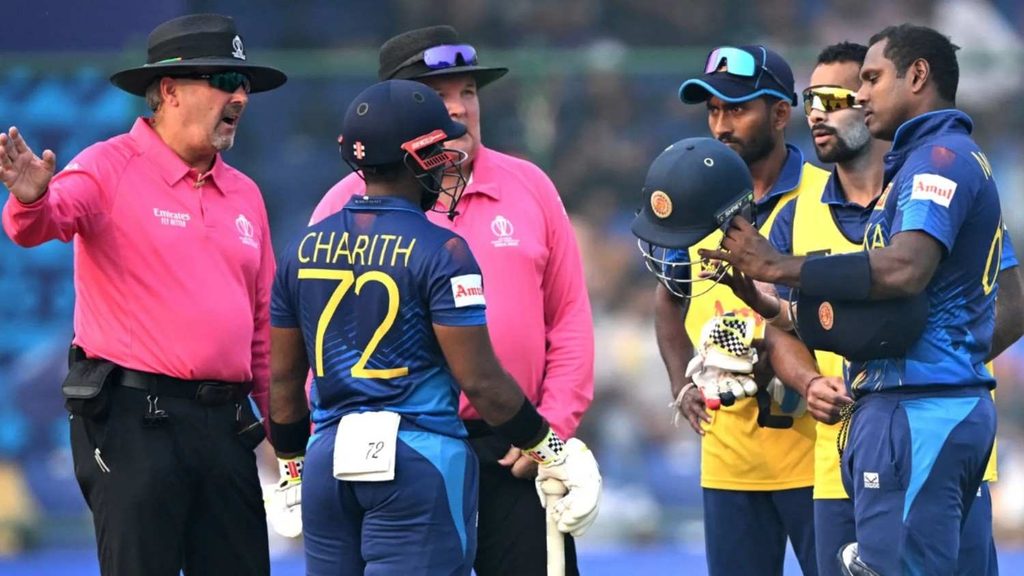
Mathews walked out to bat but encountered a problem with his helmet strap before facing his first delivery. He requested a replacement helmet, which contributed to the controversy surrounding the delay.
Bangladesh captain Shakib Al Hasan appealed to on-field umpire Marais Erasmus for timed out under Law 40.1.1 and the tournament’s two-minute requirement.
Fourth umpire Adrian Holdstock later explained that Mathews had already exceeded the permitted time before the helmet strap issue occurred: “the batter wasn’t ready to receive the ball within those two minutes, even before the strap became an issue for him.”
Mathews challenged that account, posting time-stamped video screenshots and arguing that he had five seconds left when the strap broke. He called Shakib “a cheat,” demanded “justice” from the ICC, threw his helmet and bat at the boundary, and described the incident as “disgraceful.”
Why Was Angelo Mathews’ Dismissal Controversial?
The decision triggered a major debate about the difference between following cricket’s playing conditions and respecting the spirit of the game. Mathews argued that the time-stamped footage supported his claim that he had five seconds remaining, directly contradicting Holdstock’s explanation that he was already late before the helmet strap broke.
Shakib later explained: “One of our fielders came to me and said if you appeal now he will be out.”
The umpires asked whether he wanted to continue with the appeal, and he declined to withdraw it.
Bangladesh won the match by three wickets, with Shakib named Player of the Match after scoring 82 runs and taking two wickets. When Mathews later had Shakib caught, he tapped an imaginary wristwatch.
The incident became one of the most discussed moments of the 2023 Cricket World Cup. Mathews lost his wicket without facing a delivery, becoming the first batter to suffer this dismissal in international cricket.
8. Godfred Bakiweyem: The Ghanaian T20 Cricket Case
Godfred Bakiweyem of Ghana was dismissed timed out against Sierra Leone during the 2023–24 season.
The incident is included in Wisden’s documented list of men’s professional timed-out dismissals and is identified as the first such dismissal in T20 cricket.
Bakiweyem did not meet the applicable timing requirement, resulting in his dismissal.
His case demonstrated that timed out was not restricted to first-class cricket or longer formats.
The incident is especially notable because shorter-format cricket places greater emphasis on maintaining the pace of play.
Bakiweyem’s dismissal remains an important entry in the history of timed-out dismissals in men’s T20 cricket.
9. Saud Shakeel: The Pakistan Domestic Cricket Case
Pakistan batter Saud Shakeel was dismissed timed out while representing State Bank of Pakistan against Pakistan Television during the 2024–25 domestic first-class season.
His dismissal occurred during an extraordinary sequence in which State Bank of Pakistan lost four wickets in three balls.
After the preceding dismissal, Shakeel did not become ready to bat within the required period. Reports indicate that he took approximately four minutes to emerge, leading to an appeal from the opposition.
The umpires upheld the appeal, and Shakeel was recorded as timed out.
A match official said Shakeel reached the crease after the three-minute limit. Reports suggested that he had been waiting for his turn to bat and may have dozed off during the unusually late, floodlit final played during Ramadan. The suggestion that he had fallen asleep was not established as a confirmed explanation.
His dismissal became the latest entry in Wisden’s published list of nine men’s professional timed-out cases.
The incident demonstrated that even experienced international cricketers can be affected by the timing requirement during domestic matches.
10. Ritshi Choden: The First Woman Timed Out in International Cricket
Bhutan’s Ritshi Choden became the first woman to be dismissed timed out in international cricket during a match against Nepal Women on 4 June 2026.
The incident occurred during the ACC Women’s Premier Cup at the Kolej Tuanku Jaafar Cricket Oval in Mantin, Malaysia.
Nepal Women scored 113 runs in 20 overs before Bhutan began their chase.
On the first ball of Bhutan’s innings, opener Ngawang Choden was bowled for a golden duck by Kabita Kunwar.
Ritshi Choden was due to bat at No. 3 but was not ready within the applicable time limit. Reports of the match described a two-minute deadline for the incoming batter.
Bhutan were 0 for 2 after a single delivery. Nepal appealed for timed out, and the umpires Ankita Guha and Sun Meng Yao upheld the appeal. Nepal fielder Puja Mahato went to the umpire and began celebrating. Ritshi Choden arrived carrying her helmet and gloves, spoke briefly with the umpire, and left without protest. She was dismissed for zero without facing a delivery.
Bhutan eventually finished on 62/8 in 20 overs, losing the match by 51 runs while chasing 114.
Why Was Ritshi Choden’s Dismissal Significant?
Choden’s dismissal marked the first recorded instance of a woman being given out timed out in international cricket.
The incident attracted attention because it occurred at the beginning of Bhutan’s innings, immediately after the first delivery.
It also generated discussion about sportsmanship and the use of the timed-out rule.
Following the match, the Cricket Association of Nepal (CAN) apologised, stating:
“While the dismissal was effected within the laws of cricket, we recognise that the spirit of the game extends beyond the written laws and must remain central to our conduct at all times.”
CAN also apologised to Bhutan Cricket, the player concerned and other stakeholders, reaffirming its commitment to sportsmanship, mutual respect and fair play.
Choden’s case remains a milestone in women’s international cricket and demonstrates that the timed-out rule applies across men’s and women’s competitions.
Can a Bowler Get Credit for a Timed-Out Wicket?
No. A bowler does not receive credit when a batter is dismissed timed out.
Under Law 40.2 of the MCC Laws of Cricket, the dismissal is recorded against the batter, but no wicket is credited to the bowler.
This differs from dismissals such as bowled, caught, LBW and stumped, which can count towards a bowler’s individual wicket tally.
For example, Angelo Mathews was dismissed timed out against Bangladesh in the 2023 World Cup, but no Bangladesh bowler received credit for his wicket.
The dismissal affects the batting team’s score and wicket count without increasing any bowler’s individual tally.
Can a Batter Be Timed Out in Test, ODI and T20 Cricket?
Yes. A batter can be dismissed timed out in Test, ODI and T20 cricket, subject to the applicable playing conditions.
The rule applies across formats, but the permitted time can vary between competitions.
Timed Out in Test Cricket
Timed out is possible in Test cricket. The standard MCC Laws provide a three-minute limit, and ICC Test playing conditions have also specified three minutes.
However, no timed-out dismissal in men’s Test cricket appears in Wisden’s documented list of nine men’s professional cases.
Timed Out in ODI Cricket
Timed out is also possible in One Day International cricket.
Angelo Mathews became the first batter to be dismissed this way in international cricket during the 2023 Men’s Cricket World Cup.
The tournament’s playing conditions required the incoming batter to be ready within two minutes.
His dismissal demonstrated that a batter could lose a wicket before facing a ball in an ODI.
Timed Out in T20 Cricket
Timed out can occur in T20 cricket when a batter fails to meet the relevant competition’s timing requirement.
Applicable ICC T20I playing conditions can specify a 90-second limit, although the conditions for a particular tournament must be checked separately.
Godfred Bakiweyem’s dismissal against Sierra Leone during the 2023–24 season was identified by Wisden as the first such dismissal in T20 cricket.
Ritshi Choden’s dismissal against Nepal Women in June 2026 became the first recorded timed-out dismissal involving a woman in international cricket.
Players must therefore understand the specific playing conditions rather than assume that every cricket format uses the same time limit.
Conclusion
Timed out in cricket is one of the sport’s rarest dismissals because it results from a delay between batters rather than an event during a delivery.
Under the standard MCC Laws, an incoming batter has three minutes to be ready, although competitions may apply different limits. The 2023 Men’s Cricket World Cup used two minutes, while applicable T20I playing conditions can specify 90 seconds.
The nine men’s professional cases recorded by Wisden include Andrew Jordaan, Hemulal Yadav, Vasbert Drakes, Angelo Mathews and Saud Shakeel. Mathews’ dismissal in the 2023 World Cup brought worldwide attention to the rule.
Ritshi Choden’s dismissal in June 2026 marked another milestone as the first such case involving a woman in international cricket.
Together, these 10 notable cases demonstrate why batters must be ready within the required time and how an uncommon rule can influence a cricket match.
Frequently Asked Questions About Timed Out in Cricket
Timed out means an incoming batter is dismissed for failing to meet the required time limit after a wicket falls or another batter retires. The incoming batter must be ready to receive the next ball, or the other batter must be ready to receive it. The fielding side must appeal for the dismissal.
These 10 notable documented cases combine the nine men’s professional dismissals recorded by Wisden with Ritshi Choden’s historic women’s international dismissal. They do not represent every timed-out dismissal in cricket history.
Angelo Mathews of Sri Lanka became the first batter to be dismissed timed out in international cricket against Bangladesh on 6 November 2023 during the ICC Men’s Cricket World Cup.
Bhutan’s Ritshi Choden became the first woman to be dismissed timed out in international cricket against Nepal Women on 4 June 2026 during the ACC Women’s Premier Cup in Malaysia.
No. Under Law 40.2 of the MCC Laws of Cricket, the bowler does not receive credit for a timed-out dismissal. The wicket counts against the batting team but not towards any bowler’s individual wicket tally.